4 min read


A closer look at handmade ceramics from Hvar
Across Croatia, Slovenia and Montenegro, J2Collection is not defined by stories of properties or places alone — but by the local people who shape them. Our collection brings together individuals across different fields, among them artisans who stand out through their originality, local identity and personal approach to craft.
Marino’s days move between work in travel and time spent making ceramics. In this conversation, Marino reflects on his path into ceramics and the influence of Hvar on the objects he creates. He also offers a glimpse into a special collaboration with Journey2Croatia, an experience created together in his studio.


– Clay entered my life in the winter of 2018, when I was studying in Zagreb and working in a cocktail bar that was just getting into the signature cocktail scene. We had tiki nights, where cocktails were served in ceramic cups with Polynesian gods. I really wanted those cups, but they were expensive, so I decided to make one myself. I started watching online videos and realised the process wasn’t straightforward.
I bought a starter kit and made one cup. It was horrible and full of mistakes, but still I was very excited. When that first cup came out of the kiln I had rented, I just loved it. And that’s how my journey started.


– Now that I am six years into ceramics and able to transfer almost everything I imagine into clay, I have realised how strong an influence Hvar has on my work. I often say it’s not easy to be born in paradise ( how we see our island). There is so much inspiration here — colours, beaches, pebbles, cliffs and forests. Today, I collect wooden bark and stones with interesting textures, and I like to imprint those textures into my work.
I once created a collection for a restaurant after visiting my favourite beach, Mekicevica, known for its perfect white pebbles. I wanted to replicate that surface on the bottom of a plate, and it turned out amazing and people loved it.
– Working in travel means some months are busier than others. Living in a small town helps, as everything I need is close at hand.
Last year, I built a fully functioning studio with all the tools, equipment, kiln, wheels and plenty of shelving and storage space that I need. Now it’s easier to have one clean corner devoted to office work, while the rest of the space can be messy and dusty, and I can easily switch from one to the other.
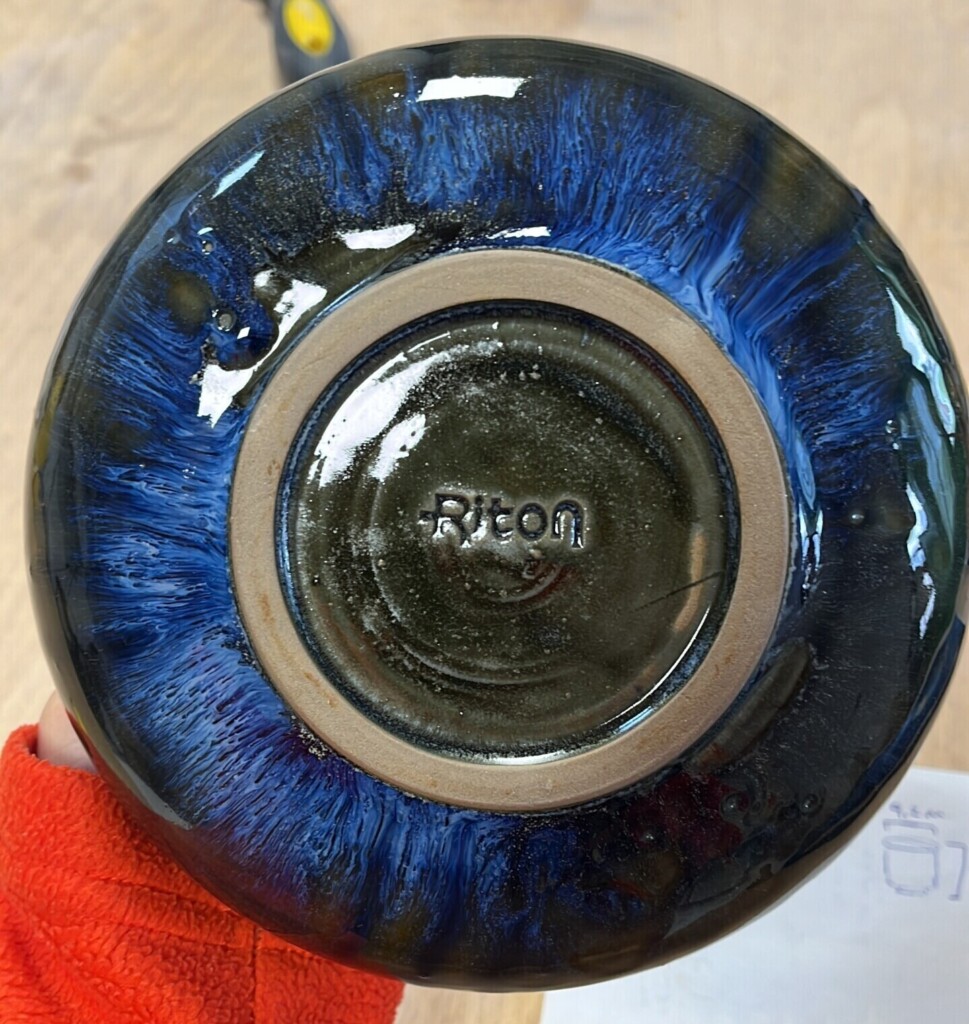
– The name Riton represents exactly what it means. Riton is the name for prehistoric ornamental vessels that were used in rituals, and sometimes even sacrifices. I chose that name because I see all my plates, pots and vases as objects that are also used in rituals — our everyday rituals, like drinking coffee or eating. The use remains similar, but the meaning has shifted, and the final theme is different.


– Yes, I’m happy that I didn’t call it Marino Ceramics in the beginning, so my partner Gui could easily become part of it without changing the core of the studio.
Gui is much more serious in her work. She was actually better on the wheel when we started, and she already had some prior knowledge from Argentina. We mostly work on our own projects, because it’s difficult for two people to think in exactly the same way at the same time.
However, the projects we work on together are, I would say, the best ones. None of us knows everything, and it’s good to have someone to talk to, to look at things from another perspective, think them through, and hear ideas that would never come to my mind on my own.
– Right now, I’m developing a few types of tiles. It’s quite simple in a way, two-dimensional, but it can also become an installation on a wall, function like a painting, or be placed on a counter. It’s something that is often undervalued, but I think it could be very interesting.
Alongside this, I’m working on a few new ideas for future collections in collaboration with J2Collection that will take shape over time, and I’m quite excited about where they’re heading. You will find out what it is soon!
– I’m happy to collaborate with Journey2Croatia, as it allows guests to take part in carefully arranged workshops and work with clay directly in the studio. The format is kept small and very personal, true to how the studio functions.
For guests, we usually offer two types of workshops. One focuses on creating ceramic jewelry, combining metal bending with small ceramic elements and special glazes. The other focuses on two-dimensional objects, such as tiles, which can include painting or engraving on the surface.


– The most unusual project I’ve worked on began when a new library was constructed here. Whenever something is built in the city centre, archaeologists have to be called. On the plot where the library was planned, they found 36 skeletons from the 3rd century AD. Each of them had a small oil lamp and some shell jewellery.
I made an agreement with the chief archaeologist to loan me a few of these oil lamps so I could reproduce them — without damaging the originals. The reproduced lamps were later used for the exhibition of the archaeological site and everything that was discovered there.
I still have the moulds, and the oil lamps still work. With a little olive oil and a small piece of rope, you get a fully functional lamp. That’s something quite incredible for me to think about, and I would say this was the most unusual project I’ve worked on.

For Marino, the most rewarding part is hearing that the ceramics shaped by his hand are truly used. When a cup becomes someone’s favourite and they reach for it every day, it becomes part of their everyday ritual — just as the name Riton itself carries meaning. That is what brings him joy.
There are already many distinctive pieces in his studio, and new works created in collaboration with J2Collection are currently taking shape and will soon find their place at your home.
Whether placed in a home, a restaurant or a hotel, these objects carry the local character of Hvar and are made to become part of someone’s everyday life.


